


The German version of this story is available here.
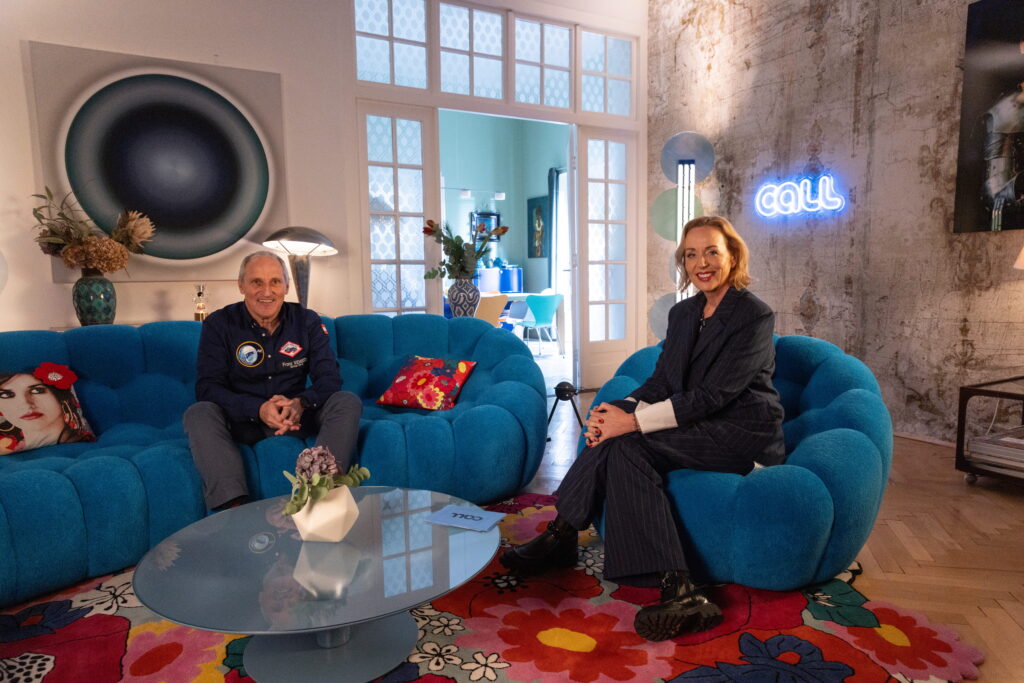
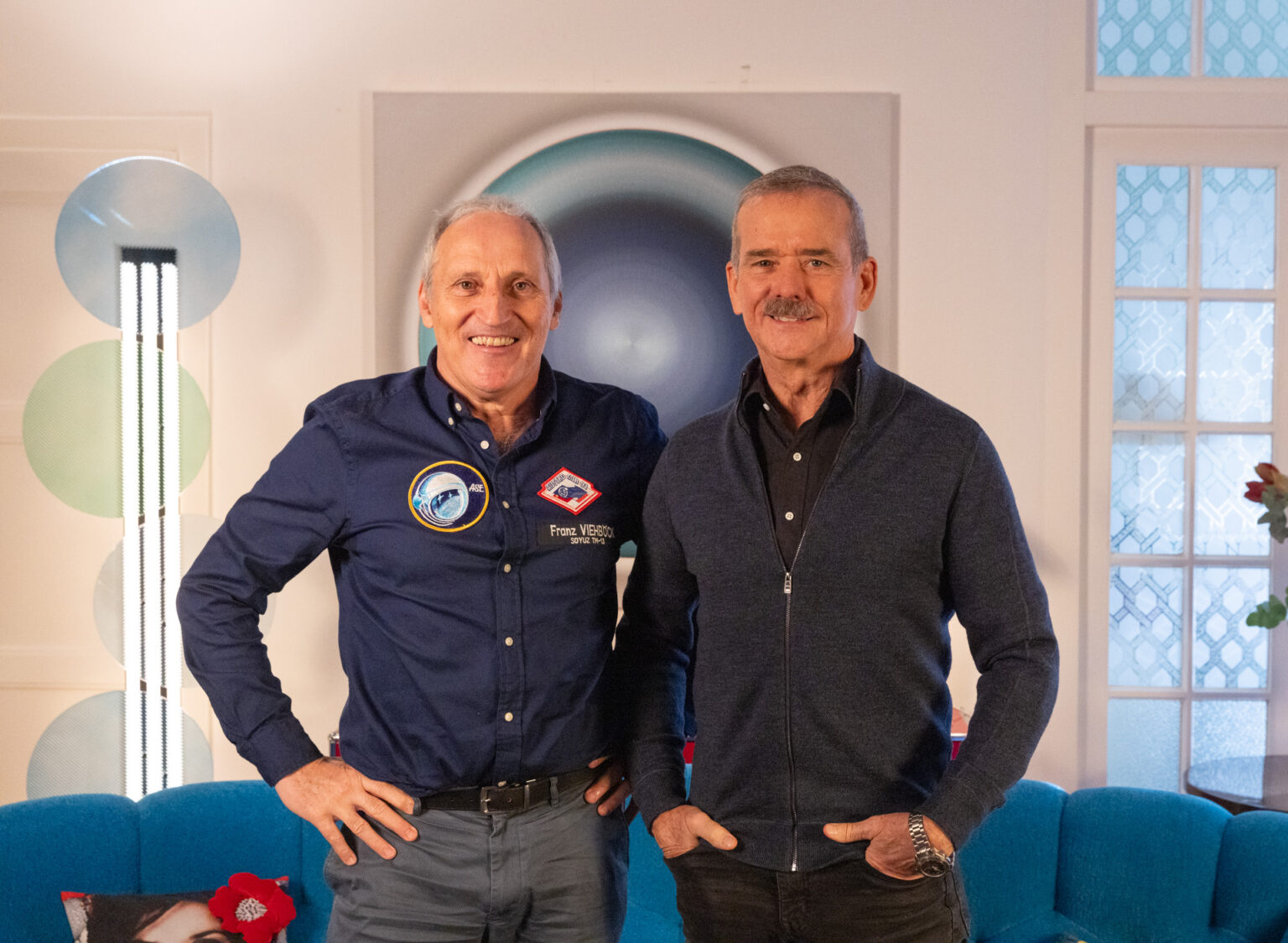
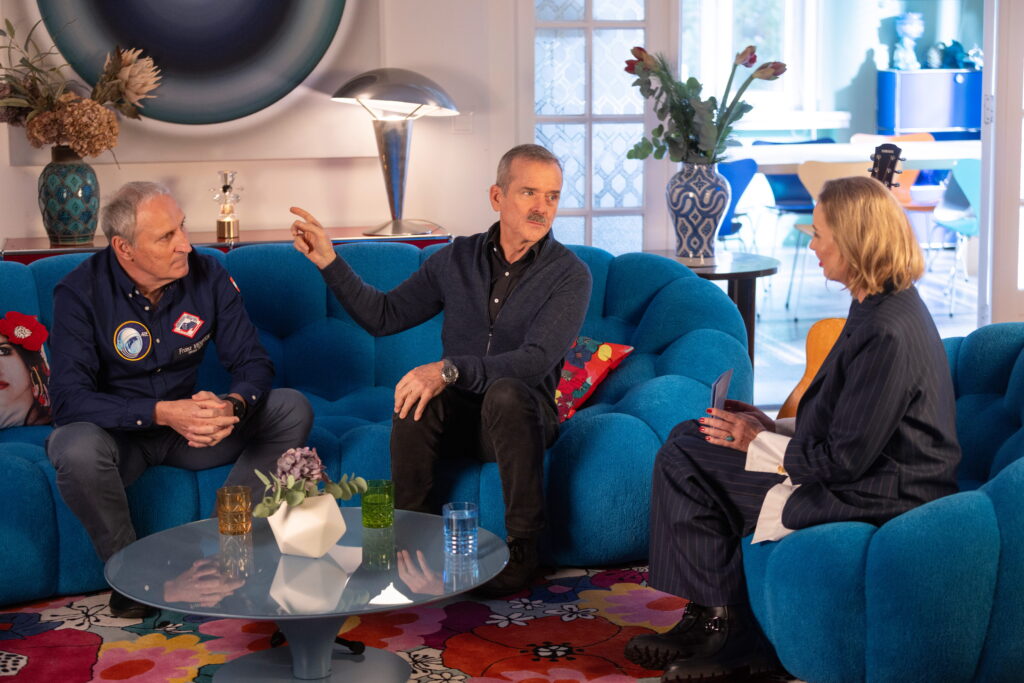
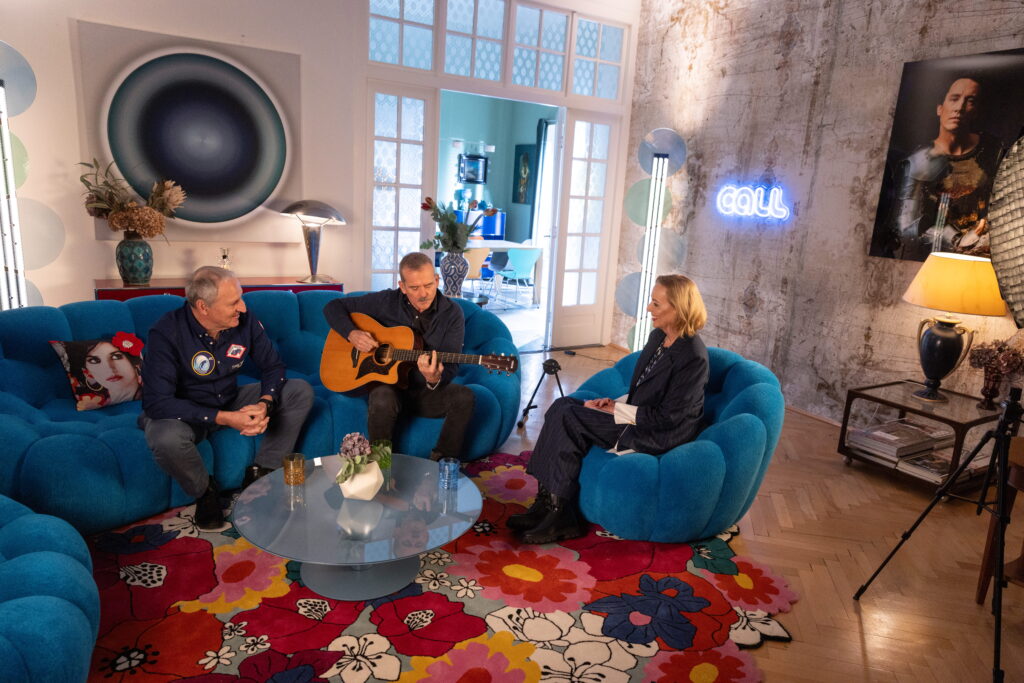
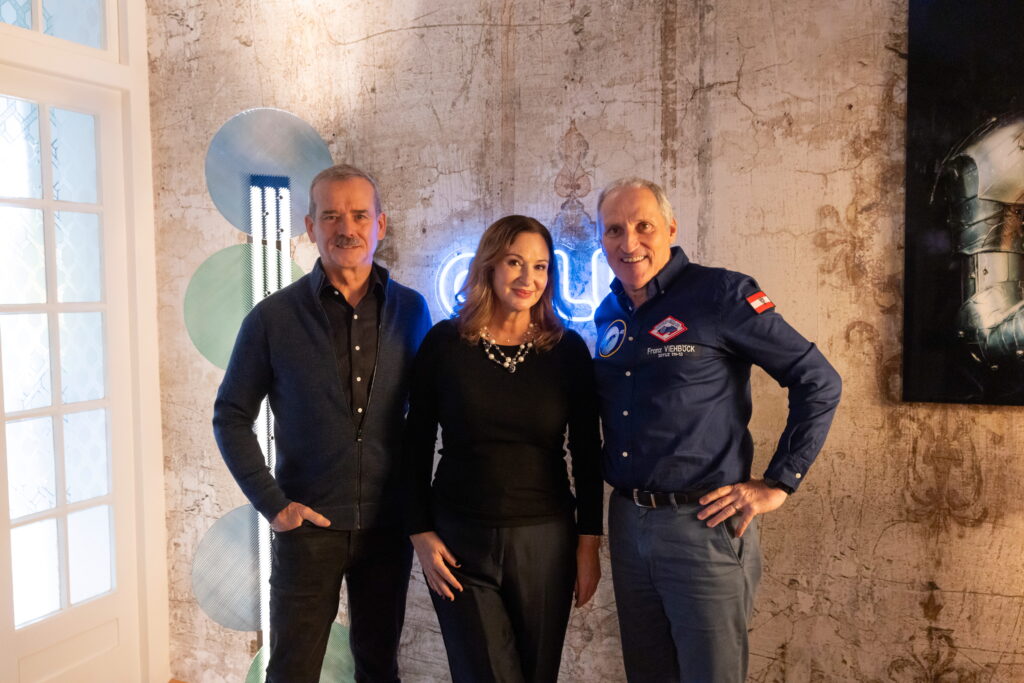
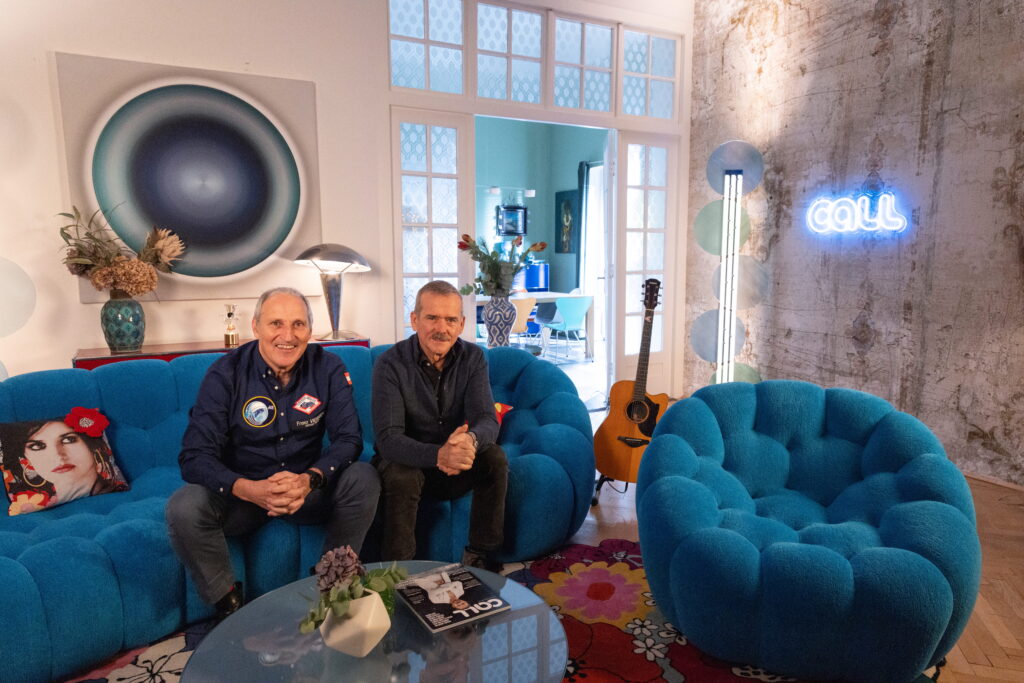
It was a meeting of two old friends bound by a singular experience: both have seen Earth from space, weightless, exposed in its fragility — a blue planet suspended in the infinite darkness beyond. Austria’s only astronaut, Franz Viehböck, now CEO of Berndorf AG, met his Canadian counterpart, Chris Hadfield, at the CALL editorial offices in Vienna, inside the newly launched CALL Studio. Their conversation marked the debut episode of Sofatalks, a new talk-show format set to air across multiple channels beginning in Spring 2026.
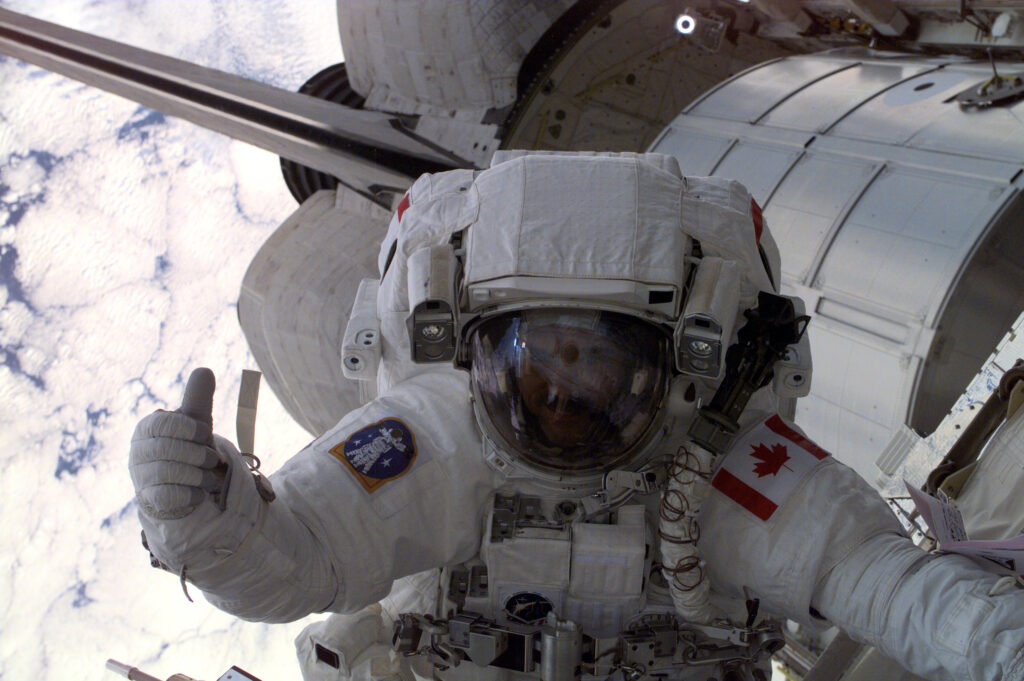
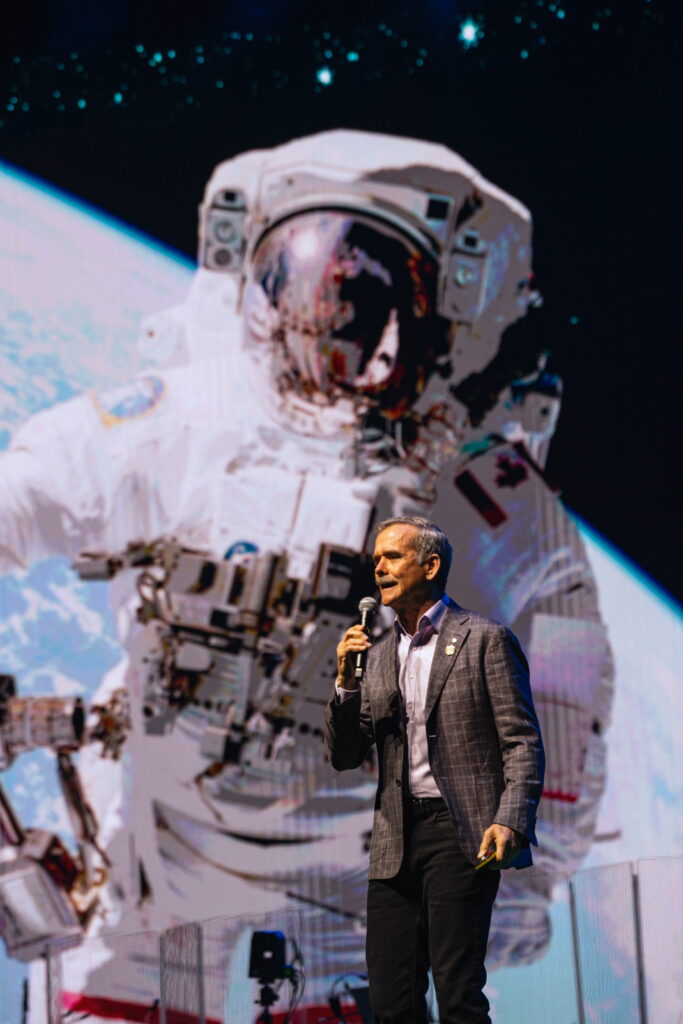
2,650 Orbits Around Earth. Colonel Hadfield spent 21 years as an astronaut, flying into space three times, commanding the International Space Station for 166 days, and traveling 112 million kilometers in zero gravity — circling the Earth 2,650 times in the process. He became arguably the most recognizable astronaut of our era when he sang David Bowie’s “Space Oddity” aboard the ISS, a video that has been viewed 56 million times on YouTube alone. “David Bowie loved my version,” Hadfield recalls. “It was the first—and only—music video ever filmed in space.”
Hadfield visited CALL as he was named, for the second consecutive year, to the annual CALL 100 list of the world’s most inspiring people — a roster chosen by an international jury that includes designer Stefan Sagmeister, Serpentine Galleries artistic director Hans Ulrich Obrist, and gallerist Thaddaeus Ropac, among others.
How long have you known each other, and what do you admire most about each other?
Viehböck: We first met probably 20 years ago.
Hadfield: There’s a professional association for astronauts called the Association of Space Explorers, and we met through that. I was the president, and Franz hosted the association here in Vienna. We’ve met many times since then. What I respect most about Franz is the amount of personal initiative it took him to turn his goals into reality. He had to work intensely hard—not only to learn Russian, but also to fly a fairly new spacecraft and succeed in a complex mission, all while being the first from his country to do so. That doesn’t happen by accident. He has a drive and an ability to get things done that I really respect.
Viehböck: He actually took away most of my speech [laughs]. If you look at his career—being a test pilot (note: for over 100 aircraft types in the US Air Force), then an astronaut, and then becoming a commander on the International Space Station—from a professional point of view, it’s just incredible. But I most appreciate him as a person. He’s a wonderful friend you can rely on. As president of the association, he had to deal with representatives from China, Russia, the United States, Canada, and Europe…
Hadfield: Even Austrians.
Viehböck: Even Austrians [laughs]. They are sitting at one table, speaking different languages, coming from different cultures and mentalities, and he had to lead this group. He did a wonderful job..
Do you share certain personality traits?
Hadfield: I served as an astronaut for 21 years with the Canadian Space Agency, with NASA, and for five years in Russia with Roscosmos. I’ve helped with multiple astronaut selections when a country decides it’s going to choose national astronauts. Like the last one in the United States—they had 9,000 applicants and chose 10. That selection process tends to produce a similar type of person in the end: a sense of humility, a really strong inner drive, confidence, but also a strong sense of mission—putting yourself second and always keeping the purpose of what you’re doing first. I think it’s a very unusual club here on Earth of people who have chosen to be astronauts. When we all get together, I find there’s a lot more similarity than difference.
Viehböck: When we get together, it feels like a family reunion. Even the young ones who join us each year, we are all the same breed.
I’m in heaven, telling my wife about it, and all of a sudden, she asked me if I could also see the smoke from the bombs that were just being dropped on Dubrovnik.
How has space changed your view of the world, your own life, and humanity?
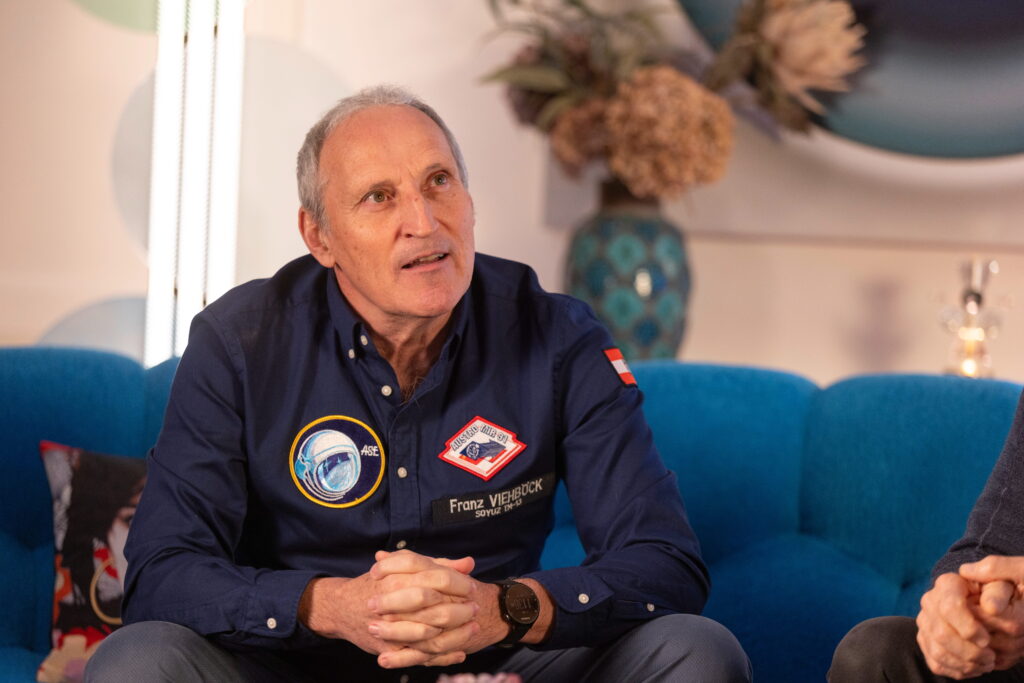
Viehböck: Flying into space is a unique experience. On the very day of my launch, in October 1991, my daughter was born a few hours after takeoff. At that time, I was on MIR [note: a space station built by the Soviet Union]. A few days into the flight, they arranged a video conference with my wife, which was a big deal back then. They brought her from the hospital to the Technical Museum in Vienna, and our president was there. We had this video call while we were flying just over Europe, along the Adriatic Sea and the Croatian coast. I was seeing the islands, and I was so enthusiastic. I’m in heaven, telling my wife about it, and all of a sudden, she asked me if I could also see the smoke from the bombs that were just being dropped on Dubrovnik [note: in the Croatian War of Independence]. At that very second, we were flying over Dubrovnik—seven kilometers per second. I looked down, and I didn’t see smoke from bombs. I saw islands, water, land. I didn’t see any artificial borders. I didn’t see any war. I thought, all this artificial stuff we create here on Earth to fight each other—what for? That gave me a lot to think about.
Hadfield: I think those hot spots in the world, where people are behaving as badly as humans can behave, have always been that way. We’re not, by nature, a peaceful species. Our closest relatives in the animal kingdom, like chimpanzees, engage in war, genocide, and murder. We’re not that far removed from them. Yet we’ve managed to build beautiful societies and cultural rules. When you’re on board a spaceship and look down, you see us at our worst—our most animal, self-destructive behavior. The beauty of being in space is that in the next 90 minutes, you’ll see everywhere else and everyone else. That’s immensely calming and grounding. You can get completely wrapped up in the negativity of one hotspot, and forget that the other 8.3 billion people are just trying to live their lives, with the common purpose of some peace, grace, laughter, and a little better future for their children. I’ve been lucky enough to orbit the Earth 2,600 times over three spaceflights, and it has made me an eternal, dedicated optimist.
I’ve been lucky enough to orbit the Earth 2,600 times over three spaceflights, and it has made me an eternal, dedicated optimist.
Having seen the bigger picture from far above Earth, how do you each envision the future?
Viehböck: When you fly into space with colleagues from different nations, it takes just a few minutes before you forget about looking down and seeing borders. It doesn’t take long until you become friends and start seeing our home planet together. That’s an experience many astronauts describe: this momentum of working together in a peaceful way. If you look at the International Space Station today, I think it’s one of the very few ventures where Americans, Russians, Japanese, Canadians, and Europeans still work together despite the conflicts on Earth. If the Americans have problems, the Russians help them. If the Russians have problems, the Americans help them in space. So, it is possible.
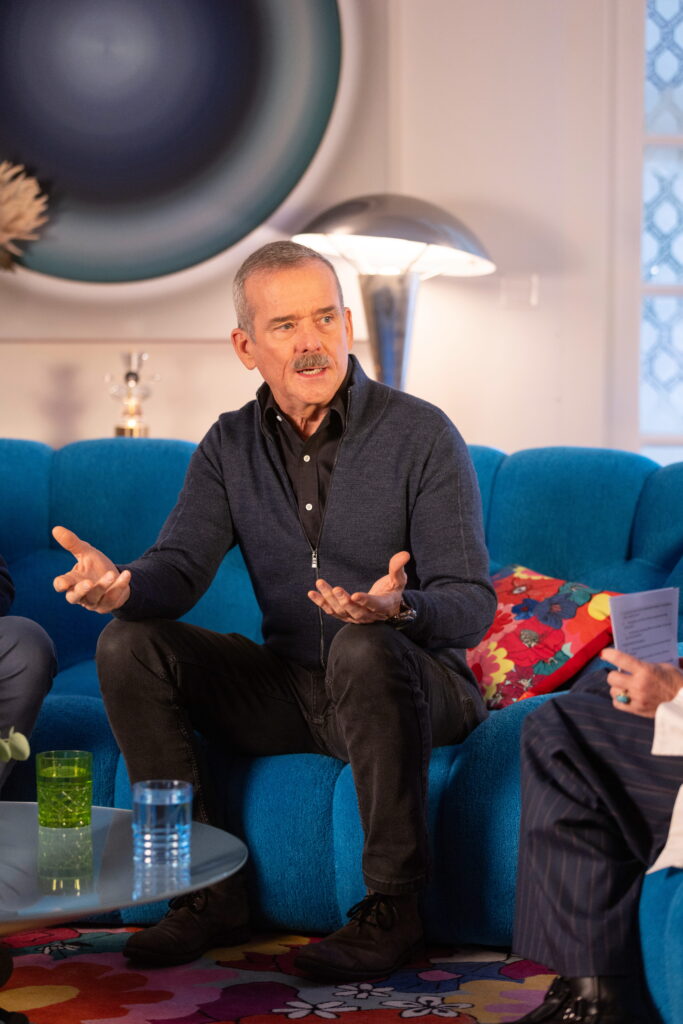
Hadfield: When I try to predict the future, it’s complicated. I look at the past, and what really gives me the greatest comfort and hope is that we’ve been here as a species for hundreds of thousands of years. With the study of the human genome, we can now get a real picture of just how ancient our species is and how it evolved from other species that were around. Somehow, we have managed—with our weaknesses, our mistakes, and our good qualities—to survive for at least 300,000 years, and it’s never been easy. It’s always been an existential challenge. We’ve endured horrific periods: plagues, things coming from space, meteor impacts, volcanic eruptions, and the wars we create ourselves. And yet we’re still here, and we’re still finding ways to cooperate. The space station is a great example, because anyone on Earth can just look up and think: “Huh, sometimes we can do things right.” I think it’s easy to despair, because it’s hard to imagine that it’s ever been this difficult in the past.
If I were lucky enough to fly to the Moon, I would do my absolute best to share that experience with everyone.
If you had the opportunity for one final space mission, which planet would you choose—and what would you hope to achieve or give back to humanity?
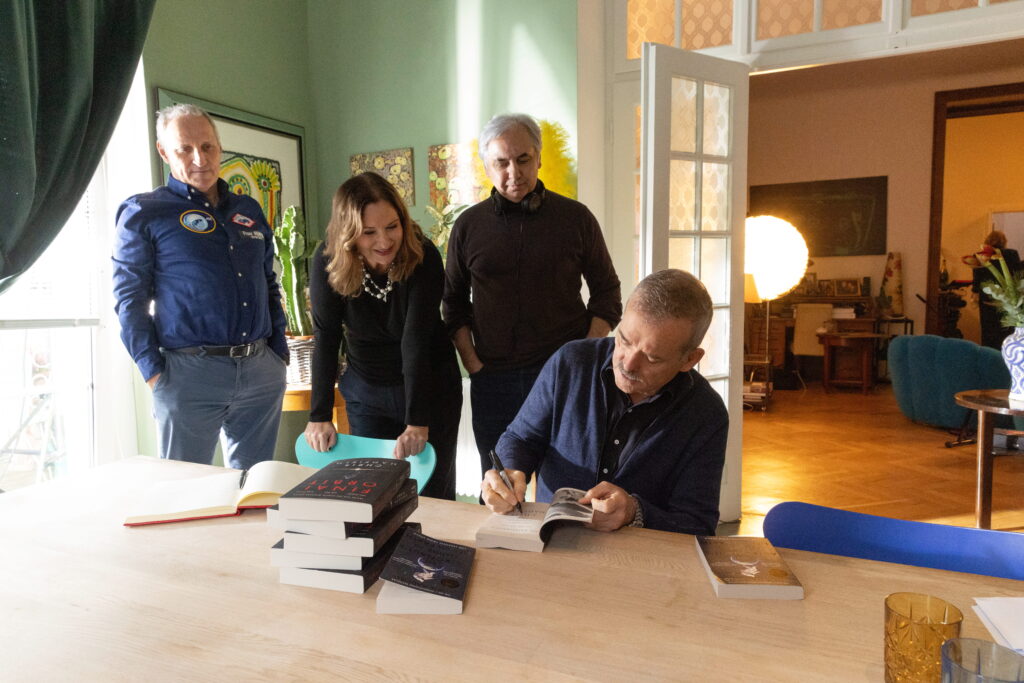
Hadfield: When I first decided I wanted to become an astronaut, I was nine years old. And like any nine-year-old, I was inspired by what someone else was doing. I was inspired by the people who were going to the Moon for the first time. In my heart, I wanted to go to the Moon and walk on it my whole life. As far as giving back, I was the lucky recipient of what NASA did back in the ’60s and ’70s. They opened their knowledge to everybody. They shared the experience so it could inspire millions of people around the world. I think I internalized that from the very beginning, and I’ve done my absolute best—whether it’s playing guitar, writing books, speaking in Vienna, doing a television series like CALL, or teaching at a university. Everything I do is a form of payback, sharing this understanding of where we are in history and the fact that if you give yourself a dream and follow a certain path, it’s possible to change who you are and make amazing things happen. If I were lucky enough to fly to the Moon, I would do my absolute best to share that experience with everyone.
Viehböck: The Moon would also be my goal. Going to Mars would be interesting, but probably not in my lifetime anymore.
Hadfield: I think we’re not ready yet to fly to Mars. There are still challenges ahead. Technologies still need to be developed for humans to survive the trip. You only have a certain window of opportunity—the trip takes about six months, then you have to stay there and fly back six months later. By the time all that happens, I don’t think my body would be in the condition to handle it [laughs].
What personal items did you bring up to space?
Hadfield: I’ve flown in space three times, and depending on which rocket you’re on, the rules for what you can bring are different. The Space Shuttle was like a big truck—it could carry a lot of stuff. You could bring items from your school or family; for example, my great-grandfather’s military medal. My brother wrote a song, and I brought the piece of paper with the song on it. All lovely little personal things. Then, being able to have them float by the window, take a picture of them with Earth in the background, and bring them back—that was special.
Viehböck: I wasn’t that lucky. I didn’t fly on the Shuttle; I flew on a Soyuz rocket, where you could carry only very limited items. I had official personal items provided by the Austrian government: Mozart balls, some Tyrol ham, and other Austrian specialties, which I gifted to the crew on the space station. Then I had my own personal items, which, if I remember correctly, could weigh up to 230 grams. And you won’t believe it, but I took along a music cassette—music from Fritz Gulda, but also The Dark Side of the Moon by Pink Floyd, and of course Rocket Man. I also had a special drink that a friend of mine, who owns a cottage in the mountains, had developed himself. I promised him I would take a little up to the space station. It was alcoholic. So, I took a little bottle of eye drops, emptied it, put the drink inside, took it into space, and brought it back.
We don’t have a fridge on the space station, we don’t have a stove, an oven, a freezer, or a microwave. How are you going to make tasty food?
Speaking of food, I tried space food once at the NASA center: It didn’t taste good.
Hadfield: I wouldn’t go to space for the food—it’s not the reason. You can hardly bring anything on your own, just a tiny little package. Food has to last a long time, and it has to be nutritious. It must stay on the shelf for months or even years, and it can’t be refrigerated. We don’t have a fridge on the space station, we don’t have a stove, an oven, a freezer, or a microwave. How are you going to make tasty food? You just get a little packet, put it in a small oven, warm it up, cut it open, and eat everything out of the package. You don’t need a plate, because everything would float off it. It’s like being on a camping trip with stuff you can throw in your backpack. I came back healthy. But it’s definitely not a restaurant.
Viehböck: On the other hand, you enjoy eating when you’re hungry and with the crew. Yes, the food is different—tubes, juices, or dehydrated meals.
Hadfield: Chocolate is great because it’s dense. It doesn’t take up much room, and it lasts a long time. We put Velcro on all the little chocolate bars and containers, and we just had a wall of chocolate. As you float by, you could grab one and break off a piece. There are some treats up there, too.
What was your greatest highlight in space—and your most frightening moment?
Viehböck: As I mentioned, I became a father a few hours after the launch, which I didn’t know at the time. I had just been informed that my wife was at the hospital, and it was only the next morning that I found out. But the whole of Austria already knew, because the news had gone through the media. They weren’t allowed to wake us once it reached mission control in Moscow. It was incredible, because the news put the whole crew into a state of euphoric, flowing work. We had some minor issues, but since the mood of the team was so good and so euphoric, working through them was no problem. I actually never had a single moment of fear.
During my first spacewalk, I was blinded in both eyes for about half an hour due to contamination in the suit.
Hadfield: It’s interesting, because you prepare on the ground, you train in simulators for all kinds of emergency situations, and then the real flight is almost boring—because nothing happens. Of course, there’s excitement during takeoff, no question about it. But it’s far from fear or panic. Fear and danger are different things. In English, we tend to treat them as if they were the same word. We say, “Oh, that’s a scary thing.” Things aren’t scary—sometimes people are scared. But the greatest antidote to fear is competence. If you’re learning to ride a bicycle, it’s dangerous. But once you’ve learned, you don’t need to be afraid anymore. A Soyuz or a Space Shuttle is just a complicated bicycle—you just have to accept that it’s a risk you need to take. The most dangerous thing that happened to me was during my first spacewalk: I was blinded in both eyes for about half an hour due to contamination in the suit. But every time you blink, you’re temporarily blind, and you don’t die. Just because you can’t see doesn’t mean the world has ended. It was something that happened, and we’d trained for it..
If you’re learning to ride a bicycle, it’s dangerous. But once you’ve learned, you don’t need to be afraid anymore. A Soyuz or a Space Shuttle is just a complicated bicycle.
Did you experience moments of euphoria in space?
Hadfield: The most euphoric moment for me was during a spacewalk. As we passed south of Australia in the darkness, I was outside, and we went through the southern lights of the world—the aurora. They were pouring around the ship and around me, between my legs. You see them from the ship and take pictures from the window. But to be out in the aurora like that, I just couldn’t believe it was happening in my life. Normally, you’d have the lights on, your pupils would be small, and you wouldn’t even see it—you wouldn’t have night vision. But I happened to have the lights off because I was riding at the end of the robot arm, and I saw the aurora as we passed through it. It lasted only a minute, but it was probably the richest and most amazing minute of my life.
What earthly habit did you have to unlearn in space, and what did you miss most that you wish you could have taken with you when you landed back on Earth?
Hadfield: We have exercise equipment on the space station, and that’s the only time you put shoes on because you have to exercise. So we have running shoes up there, but otherwise you’re in socks or barefoot. You know how on Earth you put on shoes—you sit, you have one leg stable, it takes two hands on one foot. The first time I tried it up there, I was banging around inside the station trying to get my socks on. I said, “By the end of my five months up here, I’m going to be good at this.” I’d take my other running shoe, float it right next to me, then focus on the one I was putting on—and never, not once in five months, when I turned around, was the other shoe still there. I’d always bumped into it or thought, “Where’s that other shoe gone?” Every single time.
Once you get good at weightlessness, it’s so much better than gravity. You can just fly everywhere. You have a superpower—you are a superman or superwoman.
So you have to relearn life in weightlessness, and your fundamental assumptions about what’s “normal” are wrong for a lot of things. Even after months, sometimes Earth is better for certain things, and space is better for others. It’s totally different. It takes a little while, but once you get good at weightlessness, it’s so much better than gravity. You can just fly everywhere. You have a superpower—you are a superman or superwoman. You can effortlessly float anywhere, way better than being grounded by gravity.
© 2026 PANAREA Studios, Vienna. The House of CALL Magazine.
The interview was first published in CALL Magazine 06/2026.
Sofatalks: The First Series
The New CALL Studio
The new CALL Studio in Vienna’s Währing district has the charm of a living room—perfect for couch conversations between people who respect and enjoy each other. The studio was designed with that in mind:
Pedro Almodóvar Collection for Roche Bobois
The iconic centerpiece of the CALL Studio is the furniture designed for Roche Bobois by legendary designer Sacha Lakic (Bubble) and Academy Award–winning director Pedro Almodóvar: the Bubble sofa and armchair (color: Ciel), the Volver Cromática carpet with a floral pattern, Confettisfloor lamps, and the Ovni Up table.
The Studio’s Central Image
Robert Schaberl’s painting ZF light turquoise and deep blue, dancing with shades of purple. 2022, Format 130×130 cm