
Note: This interview was conducted in German (the authorized original version can be found here) and has been translated into English using AI.
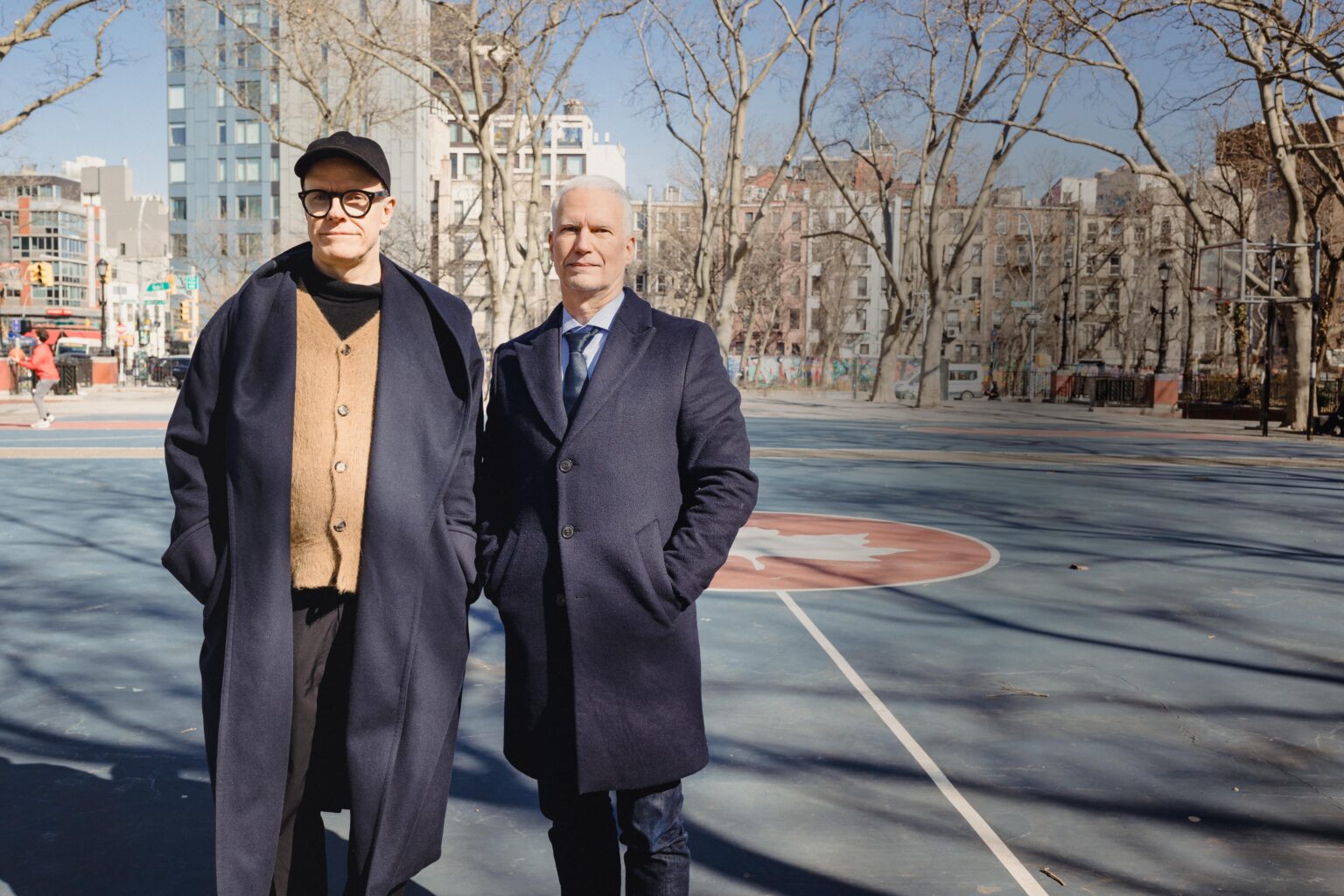
They are among the most powerful figures in the global art world. Klaus Biesenbach, 59, once shaped the curatorial vision of New York as chief curator of the Museum of Modern Art and director of MoMA PS1, before relocating to Los Angeles to lead the Museum of Contemporary Art. Today, he stands at the helm of Berlin’s Neue Nationalgalerie and the Museum Berggruen. Hans Ulrich Obrist, 57, is the artistic director of London’s Serpentine Galleries and one of the most influential curators of contemporary art alive. The British magazine ArtReview has twice placed Obrist at the very top of its annual Power 100 list—ranking him ahead of figures such as Jeff Koons, Ai Weiwei, and Larry Gagosian.
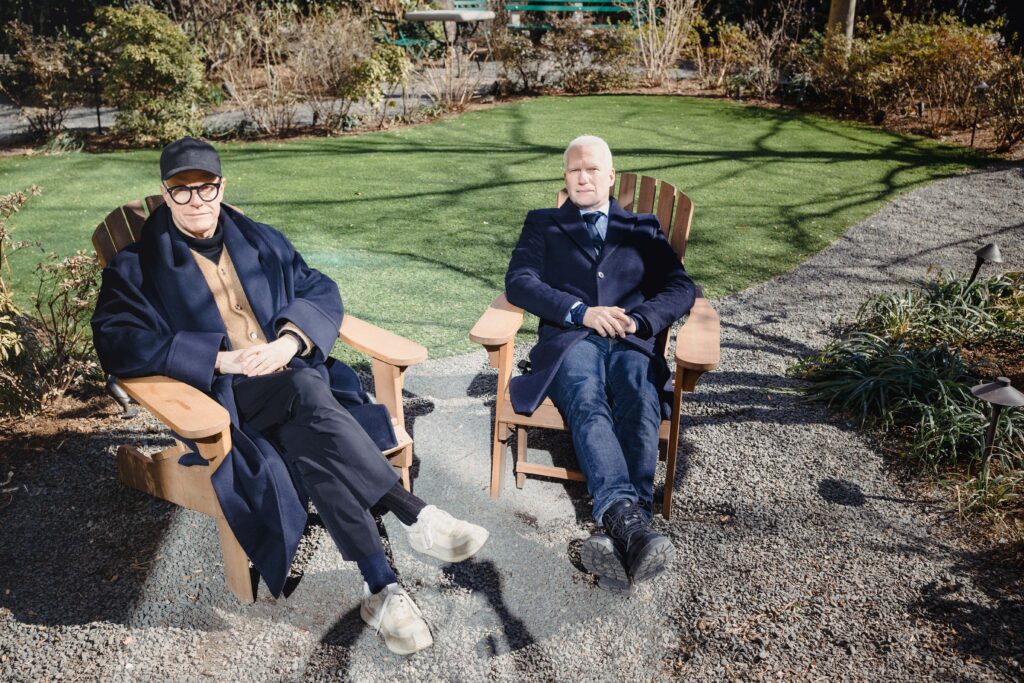
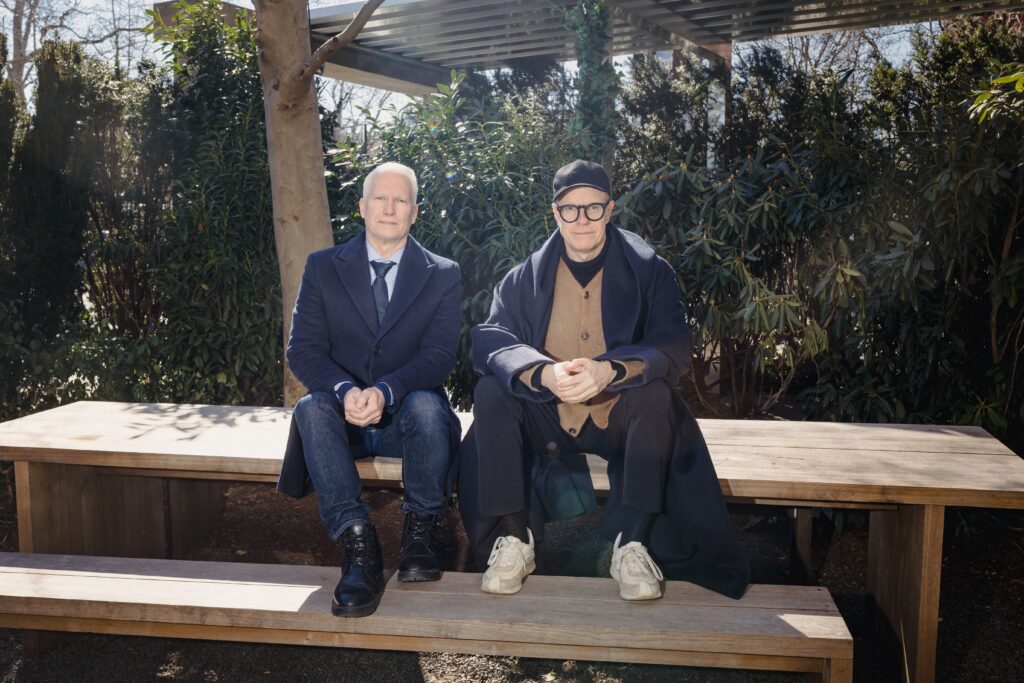
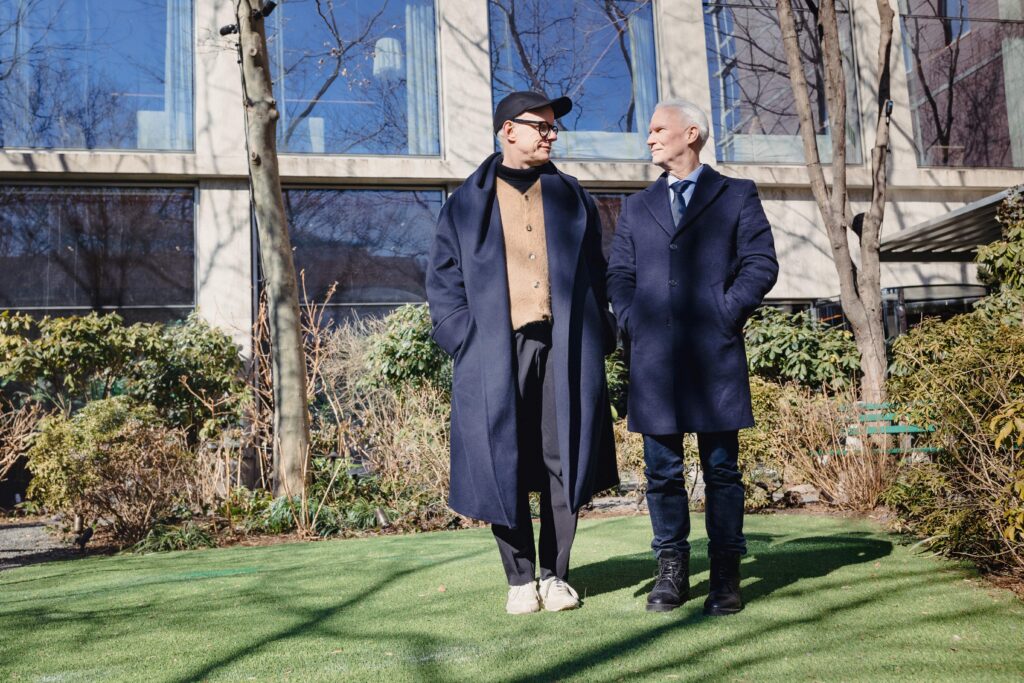
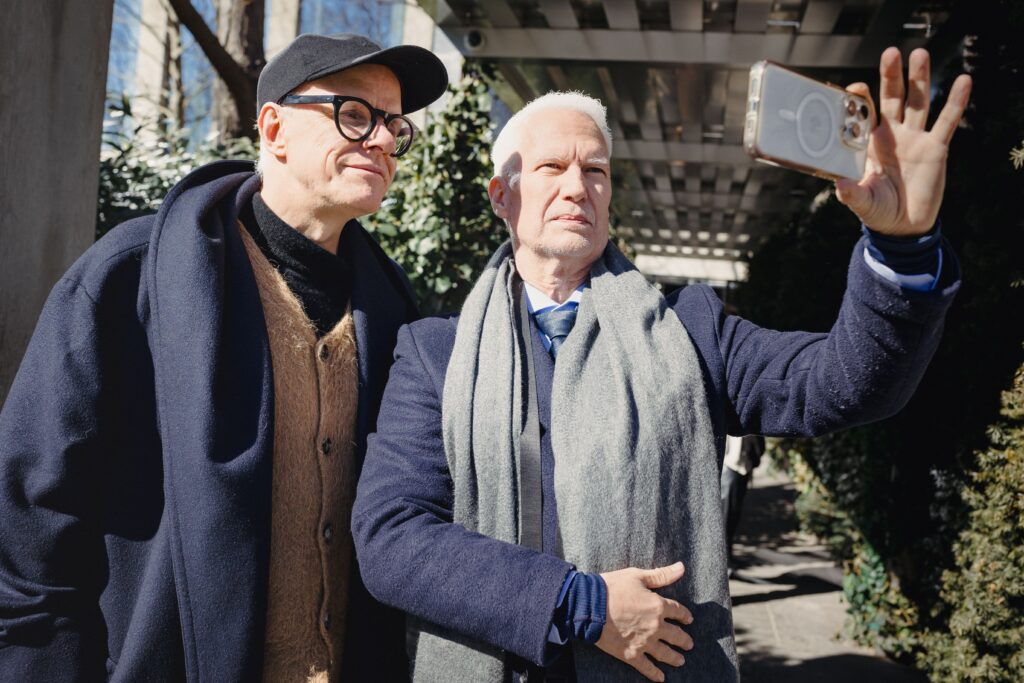
Yet Biesenbach and Obrist are more than institutional heavyweights defining what matters in contemporary art. They are also close friends, bound by more than three decades of shared ideas, ambitions, and conversations. For CALL Magazine, the two met in New York for a joint photo shoot and an open dialogue—reflecting on the future of art in the age of artificial intelligence, and on the personal histories that brought them there.
We met on the night train from Innsbruck to Venice. Hans Ulrich stepped into the compartment carrying bags full of notes.
When did your paths first cross?
Hans Ulrich Obrist (HUO): It was on a night train in Austria, in 1993. I had given a lecture in Innsbruck and needed to be in Venice the following day for the Biennale, so I took the overnight train. It came from Vienna and arrived in Innsbruck around two in the morning. The train was completely full—no seats anywhere. There was just one compartment where I could see someone sitting alone, but the door was locked from the inside. So I knocked.
Was that Klaus Biesenbach inside the compartment?
HUO: Exactly.
Klaus Biesenbach (KB): I find it very strange that this is actually the first time we’re speaking German to each other. That might explain why we didn’t speak German back then either—we were both on our way to the Biennale. It was one of my first trips to Venice. At the time, people still traveled mostly by train; there weren’t many flights. Whenever I took night trains, I would use my belt to strap the compartment door shut from the inside, so it couldn’t be opened. I’d draw the curtains as well. So, Hans Ulrich, you couldn’t even see that I was sitting there. (laughs) But the conductor—a very kind woman—knew the trick. She knew someone had turned the compartment into a private sleeper and locked it. (Both laugh.) You came in carrying bags full of notes, books, and papers and immediately spread everything out. I had the curtains closed and wanted to sleep. You needed light and space to unpack your ideas. That’s how it started.
Back then, you—the Swiss intellectual and the German medical student—spoke English to each other?
HUO: Yes. Night trains are a wonderful medium. I always had ideas on night trains—they’re ideal places to think and to work. As we discovered on that journey, they’re also perfect for starting friendships. We talked all the way from Bolzano to Venice.
KB: Until you suddenly jumped off the train in Mestre. You shouted, “My God, I have to get married!” (laughs) But we had agreed on that beforehand. At the time, I was studying medicine, and you, Hans Ulrich, were in your early twenties.
HUO: I was studying economics in St. Gallen.
KB: During that conversation, we realized we had many friends in common. There were no mobile phones then, and I don’t think I even had email yet. At some point, Hans Ulrich said, “October 1st, 10 a.m., Paris—Musée d’Art Moderne. We’ll have coffee there.” Completely absurd: a date plucked out of thin air, a place and a time easy to remember. That was our only arrangement. And somehow, we actually kept it. Otherwise, I think we would have lost touch.
HUO: Exactly. At the time, I had already begun doing some freelance work at the Musée d’Art Moderne. Since then, the dialogue has never stopped.
KB: That was over thirty years ago.
What’s interesting is that neither of us really comes from the traditional art world. At that time, there weren’t really any peers—no one our age in the art world.
HUO: What’s interesting is that neither of us really comes from the traditional art world. Still, we both became deeply involved with art very early on and formed close friendships and dialogues with artists even as teenagers. We had mentors. For me, it was Peter Fischli and David Weiss, Christian Boltanski, Annette Messager, and Gerhard Richter—relationships that go back to the late 1980s. You told me about Katharina Sieverding, about Marina Abramović, Yoko Ono—about your mentors. It was fascinating because we were just beginning our paths as curators. Yoko Ono, for example, is more than thirty years older than we are. At that time, there weren’t really any peers—no one our age in the art world. Klaus and I shared the idea of staging exhibitions in unexpected places, of inventing new venues for art. We weren’t being invited into established institutions yet, so we both developed a kind of do-it-yourself mentality.
How did one become a curator in the 1990s?
Klaus Biesenbach: Hans Ulrich and I were invited—an invitation that now seems completely obscure—by a small institution in Japan, the CCA Kitakyushu. They asked us to travel through Japan for two weeks with Lawrence Weiner, Marina Abramović, and Daniel Buren, to explain contemporary art. And yet, I myself was still so curious: “What is contemporary art?” Back then, we were just the youngsters talking about it. How does one become a curator? Honestly, I didn’t really think of it as a profession. We simply started doing it. It wasn’t intentional—it just happened.
Hans Ulrich Obrist: Figures like Harald Szeemann and Kasper König were crucial for me. Szeemann was omnipresent in Switzerland. I remember telling him: I want to be useful to art in some way. He said, “That’s called being a curator.” My parents were relieved—they thought I’d go into medicine, since curare means to heal.
You later collaborated on projects such as the Hybrid Workspace at documenta X in Kassel in 1997, an open media studio that laid the groundwork for the Berlin Biennale?
KB: I believe 1995 was the first time we both had projects in Venice. We were no longer just visitors.
HUO: Our trip to Japan was like a road tour through seven cities. It was simply called “Let’s Talk About Art.” Klaus and I would stop at 7-Eleven every night for snacks, then talk all night in the hotel. That trip really cemented our friendship. Soon after, I got an invitation from the Serpentine Gallery to organize an exhibition in 1994/95, where you could do everything you’re normally not allowed to do. That freedom fascinated us. The Serpentine found me a tiny, cheap apartment in Elephant & Castle, a relatively run-down part of London at the time. I made 50 keys and sent them to friends, saying, “If you need a place to stay in London, welcome!” Klaus was one of the first visitors. We ended up spending a lot of time there—what you still call the “Crampton Street Disaster.”
Hans Ulrich lived the Leonardo da Vinci rhythm—sleeping in 15-minute intervals every three hours. I, on the other hand, had to sleep until at least 6 a.m. Then we’d go to Burger King—already open at 6 a.m.—drink coffee in the parking lot, and start the day.
KB: I overstayed my welcome. I had no fixed schedule in Berlin, so I just stayed. Then we developed a routine. Hans Ulrich lived the Leonardo da Vinci rhythm—sleeping in 15-minute intervals every three hours. I, on the other hand, had to sleep until at least 6 a.m. Then we’d go to Burger King—already open at 6 a.m.—drink coffee in the parking lot, and start the day. We ran a kind of marathon to meet all the artists: Sarah Lucas, Tracy Emin—just brutal early mornings, one after the other.
That was the beginning of the Brutally Early Club. We later formalized it with Markus Miessen and Shumon Basar—a real 6 a.m. club.
HUO: That was the beginning of the Brutally Early Club. We later formalized it with Markus Miessen and Shumon Basar—a real 6 a.m. club. In the evenings, we often hung out with the Chapman brothers and Sarah Lucas in Soho. Bar Italia was open 24 hours. We were basically flâneurs, making time for artists and studio visits. Our neighbor was the critic Stuart Morgan, a key Frieze writer who died far too young. The documenta collaboration developed organically.
In 1997 we created a space that was part virtual reality, part AI, part internet—the Hybrid Workspace. It was ahead of its time.
KB: It was a bit of a disaster for me personally, because Hans Ulrich packed all the subtenant’s belongings into black bags and stored them in a room—it was very Berlin, circa 1990. There was a whole generation of older artists we wanted to meet. The Berlin Biennale began taking shape in 1996. We wanted to run it alongside documenta in 1997, but it didn’t work out. Then we created a space that was part virtual reality, part AI, part internet—the Hybrid Workspace. It was ahead of its time; you couldn’t tell what was real and what wasn’t. During a performance, Christoph Schlingensief was arrested by the police.
HUO: We had to get him out of the station. He had made some provocative comments about Chancellor Helmut Kohl. He had invited unemployed people to jump into Lake Wolfgang, threatening to flood Kohl’s summer residence—though only a few showed up. Our Hybrid Workspace hosted workshops and seminars reflecting on digital versus analog—a conversation that’s still very relevant today. It became part of documenta and a prelude to the Berlin Biennale. A laboratory. Our laboratory.
Hans Ulrich, you were very active in Austria at the time—curating exhibitions for Museum in Progress and at the Kunsthalle Wien. How important was Vienna back then?
HUO: Vienna was also pivotal for me. I first came there as a teenager, 16 or 17, visiting Erwin Wurm and Alois Mosbacher. Through them, I discovered Maria Lassnig. That was 1986. From then on, there was a continuous dialogue with the city. Museum in Progress in 1992, Der zerbrochene Spiegel with Kasper König in 1993—my first major exhibition featuring painting—then Cities on the Move in 1997, a decisive moment. Erwin Wurm, then on the Secession board, suggested I organize an anniversary exhibition on Asian art with his colleagues. That exhibition eventually toured the world.
Has Vienna lost importance in the art world over the last three decades?
Klaus Biesenbach: After Covid, a new geography has emerged across the globe. Unfortunately, I haven’t made it to Vienna much since returning to Europe. That’s my biggest regret, because everyone is talking about how Vienna has actually grown in significance, offering such a high quality of life. The city has gained tremendous importance for the institutional scene and for what’s happening in Europe. By contrast, many say London has lost ground since Covid—but things are settling again.
Vienna doesn’t lack artists; it lacks a major exhibition.
I agree with you on quality of life, Klaus. The real question is what’s happening culturally. Erwin Wurm is 70 now, and Lassnig and Nitsch have left us. Who is shaping the present?
HUO: I believe Austria always has interesting young artists. Klaus and I met Markus Schinwald early on. Our rule was to visit as many studios as possible. Six or seven years ago, I discovered Philipp Timischl, who works with video—it’s fascinating. Cities like Zurich and Vienna have become far more international in recent years. In the past, artists moved to a specific place. After World War II, the avantgarde migrated from Paris to New York. Later, with the Berlin Biennale, many artists moved to Berlin. Klaus invited Nancy Spector and me; we shared the same idea: let’s create a biennale that maps Berlin—a cartography. Artists from all over the world are in Berlin, the world is in Berlin. That phenomenon no longer exists. There is no new New York, Paris, or London. Today, we live in a polyphony of centers—Vienna and Zurich included. Vienna doesn’t lack artists; it lacks a major exhibition. Of course, with the Berlin Biennale, Klaus, you created that visibility elsewhere. But in Vienna, there’s still too little attention for the most exciting work happening.
KB: I’d agree. When we started the Berlin Biennale, the Sensation exhibition of Young British Artists was happening at the same time. Most of the artists we featured—Pipilotti Rist, Ólafur Elíasson, Monica Bonvicini—weren’t German. The scene was international. Artists gained enormous visibility then—and many still enjoy it today. Hans Ulrich, perhaps you’ve just invented something entirely new for Vienna. Art scenes flourish when they have moments to converge. Back in Venice, you didn’t think, “There aren’t enough artists here.” But there were spaces and moments—Paris in October, Basel in June—where chance encounters were almost guaranteed. That’s the beauty of the art world. Hans Ulrich, we’ve stayed connected because we’ve been doing compatible things for over thirty years. I’m very grateful for that.
Klaus, you joined MoMA in New York in 2004 and later took the helm at MoMA PS1 in Queens in 2010. At the same time, Hans Ulrich, you began as artistic director at the Serpentine Galleries. Do you see the art world as a single entity—or as many parallel worlds?
KB: I started at PS1 in 1996. There’s the art, the artists, and art history—the history of friendships and dialogues, like ours. And then there’s a parallel world: the art market, galleries, auction houses, the product side of art. Hans Ulrich and I have always worked alongside that, but separate from it. Thanks to early mentors—Joan Jonas, Yoko Ono, Marina Abramović, Katharina Sieverding, Dan Graham—we’ve stayed on the side of artists and art history. That’s the beauty of art: so many parallel worlds exist, often disconnected from each other.
When photography was invented, painting didn’t disappear—it reinvented itself.
HUO: When photography was invented, painting didn’t disappear—it reinvented itself. When video art emerged with Nam June Paik, Dara Birnbaum, and other pioneers, photography didn’t vanish. It’s the same with new technologies: they add parallel realities. Twelve years ago, we started a technology department at the Serpentine with Ben Vickers. Back then, museums only engaged with technology via their websites. Now, we have five curators dedicated to digital media. We’ve been working with AI and blockchain for over a decade. We don’t just create tech exhibitions—we integrate digital dimensions into traditional media projects. For instance, we’re working with Indian painter Arpita Singh on a pure painting exhibition, while also collaborating with Google to digitize her work. Technology becomes an additional layer. At the same time, this department allows for fully tech-driven projects, like Holly Herndon and Mat Dryhurst’s AI choral work, a large-scale system of twelve choirs. Klaus, it’s similar to what you did at MoMA: building a new department. At MoMA, you focused on expanding the collection; at the Serpentine, it’s about producing new realities with artists. Both approaches are equally relevant. We’ve also created a department focused on ecology.
KB: At MoMA, my title was Chief Curator at Large. My colleagues always joked, “Klaus is responsible for everything that doesn’t fit on a pedestal or in a frame.” Later, a group of former colleagues visited Anne Imhof, and one of them said, “It doesn’t fit on a pedestal, and it doesn’t fit in a frame.” (laughs) Hans Ulrich, you’re incredibly encyclopedic. You’ve spoken to every artist, you’re an archive of quotes and conversations—and yet you manage to do it all while embracing the new. You discover emerging talent, nurture it, and create opportunities for new work with tremendous curiosity and generosity. It’s fascinating that you balance both—preserving the past while inventing the future. I think we’ve both stayed true to that approach over the decades.
HUO: Absolutely. We speak on the phone every few weeks, exchanging ideas about interesting new artists. I saw your Andy Warhol exhibition, Klaus—it offered a completely contemporary, fresh perspective on a historical figure. The future often emerges from fragments of the past, through new ways of seeing what already exists.
You both make extensive use of social media: Hans Ulrich, you have 414,000 Instagram followers and 5,648 posts; Klaus, you have 308,000 followers and 8,901 posts (Note: Instagram figures were updated for the online version of this interview in February 2026). That reaches many times more people than the world’s largest art magazines. As a curator or museum director, does that make you also a publisher today?
KB: I admire Hans Ulrich for the way he continues to grow this presence. Around the time of Covid, you just kept going, generously. My relationship with social media has shifted—I’m becoming more aware of its complexity. Marina Abramović once pulled me aside and said, “You owe it to your artists—you have to communicate, to support them.” I once studied how Joseph Beuys engaged with the public: he communicated when it served the work or its message. Hans Ulrich has reached another level. He brings the content and the artists to the forefront in a way that is both authentic and powerful.
HUO: The question has always been: How can you be useful to art? The second point is that we’ve always invented new rules of the game. Take 11 Rooms, one of our favorite collaborations—it started in Manchester, where I always work for the festival, and I invited Klaus to join me. The project continues to grow; next year, it will be 26 Rooms. The rule is simple: each room has a door, behind which visitors encounter a living sculpture. At 6 p.m., the sculpture goes home. It’s an exhibition of living situations, not objects. That’s how we think about time, similar to the way we approach space and time on social media. Instagram, for instance, was invented as an image-sharing platform—but I’ve always used it differently. For my handwriting project, I post the handwritten notes of artists, poets, and others—around 2,500 so far. Sir Roger Penrose, the 94-year-old Nobel laureate, once wrote, “I have spent my whole life trying to understand the universe.” I said, “Write it down.” Instagram becomes its own exhibition space this way.
KB: My own window project has been “algorithmized away.” In the beginning, I photographed a view from my window every day, inspired by Yoko Ono and On Kawara. But today, the logic of social media no longer allows that. But let’s return to Vienna. I imagine a project like 26 Rooms could make you experience a city entirely differently. New York will always be my true home at heart. When you stage an exhibition in your own city, you become acutely sensitive to its rhythms. Douglas Gordon always said, “Art is a great excuse to talk about the really important things in life, like life and death and love.” I believe that in real life, art must be experienced in person; it cannot be fully reproduced in the media. That’s the beauty of this project, which we’ve been doing for fourteen years. You enter a room and encounter a sculpture—always a living person, never the artist themselves.
© 2026 PANAREA Studios, Vienna. The House of CALL Magazine.
This interview was originally published in CALL Magazine 02/2025.